skip to content

Use cases

From a question
to your next discovery.

Deliver client work. Understand what changed. Test what could work next. Explore how to turn your data and ideas into analysis, interactive tools, and work you can build on.

01 / Client work

Your best thinking. Ready for the next engagement.

For specialist advisers and engagement teams

Every client brings different records. Your team brings a method. Put them together in a working review that makes the evidence, calculations, and open questions easier to explore.

Start with one diligence analysis or evidence review. Keep improving the method as you bring it to the next engagement.

Explore client delivery
A place to start
Client records, supporting evidence, and your review method.
What to measure
Preparation and review time, evidence requests, and reuse across engagements.
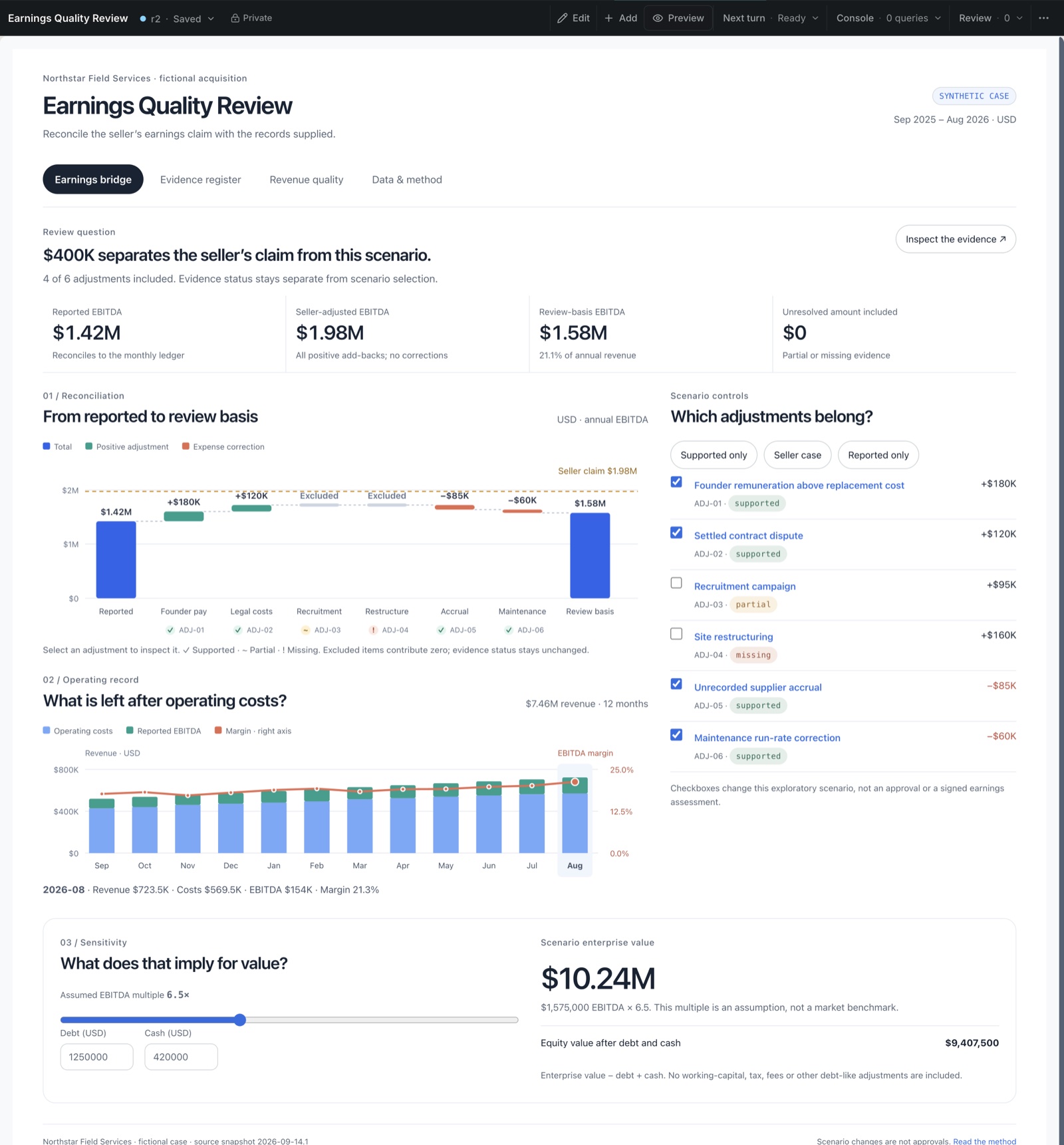
Earnings Quality Review in Proforma, with an earnings waterfall, monthly operating results, and evidence supporting the adjustments.
Earnings Quality Review · Actual product capture · Synthetic records
Look inside the analysis

02 / Business reviews

A report tells you what changed. Go find out why.

For finance, operations, and analytical teams

A margin shift. A customer concentration. A forecast that missed. Bring the numbers and the questions into one workspace, then follow the detail behind the headline.

Turn useful analysis into an App for the next operating review. Give your team a place to refresh the inputs, explore exceptions, and compare what to do next.

Bring a recurring report
A place to start
Reports, exports, operating definitions, and a decision to make.
What to measure
Time to refresh and investigate, corrections, and decision turnaround.
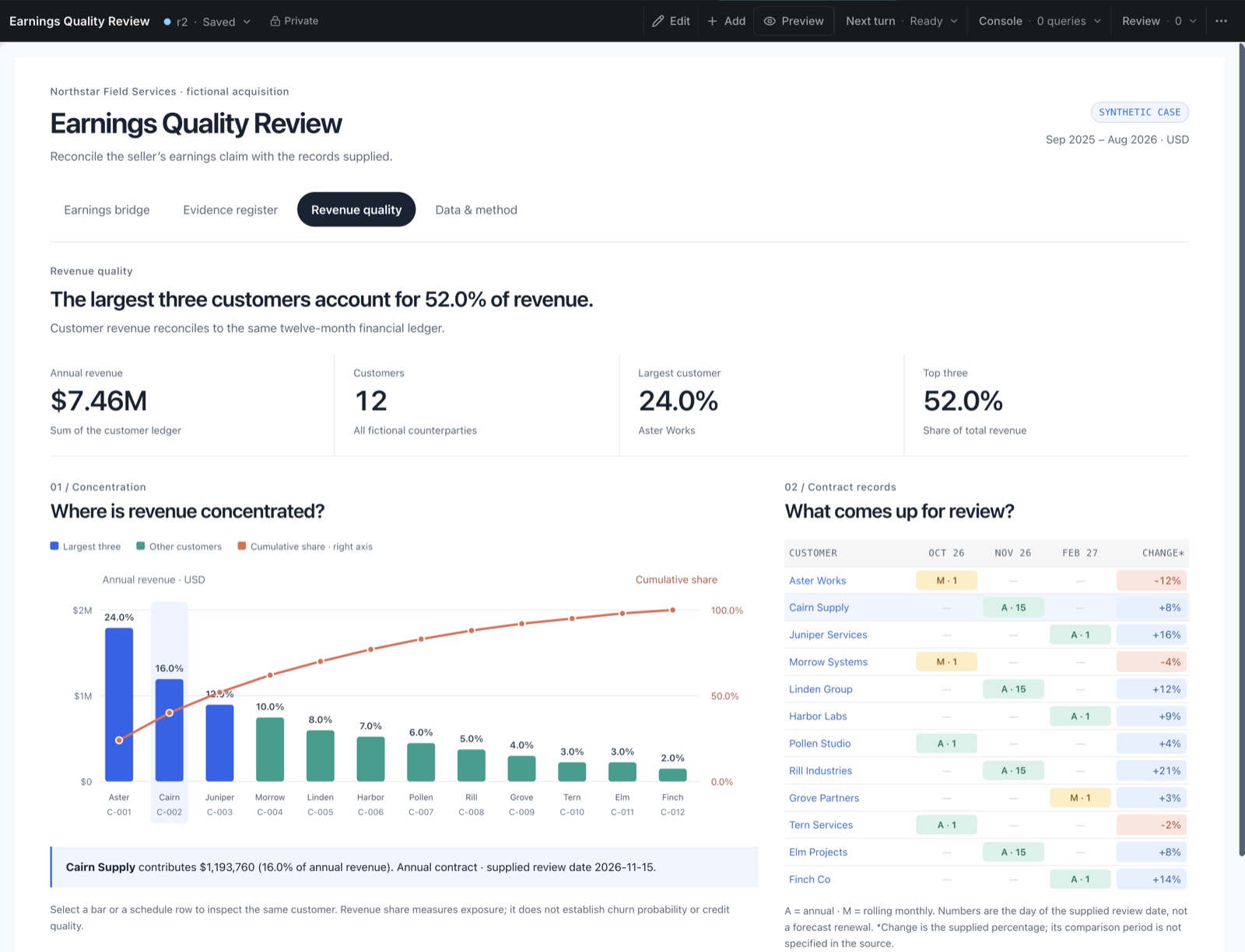
Revenue analysis in Proforma showing customer concentration, cumulative revenue, and a contract review matrix for fictional customers.
Revenue quality analysis · Actual product capture · Synthetic records
Explore the working example

03 / Testing ideas

Give your next ‘what if’ somewhere to go.

For product, operations, and R&D teams

Explore a pricing change, a different process, or a technical approach. Make the assumptions visible, compare alternatives, and choose a method that can answer the question.

A scenario helps you estimate. An experiment helps you test. Keep the result with the method, then use what you learn to decide what comes next.

Discuss an idea
A place to start
A baseline, possible alternatives, and a measure of success.
What to measure
Time to compare approaches, observed results, and the next decision.
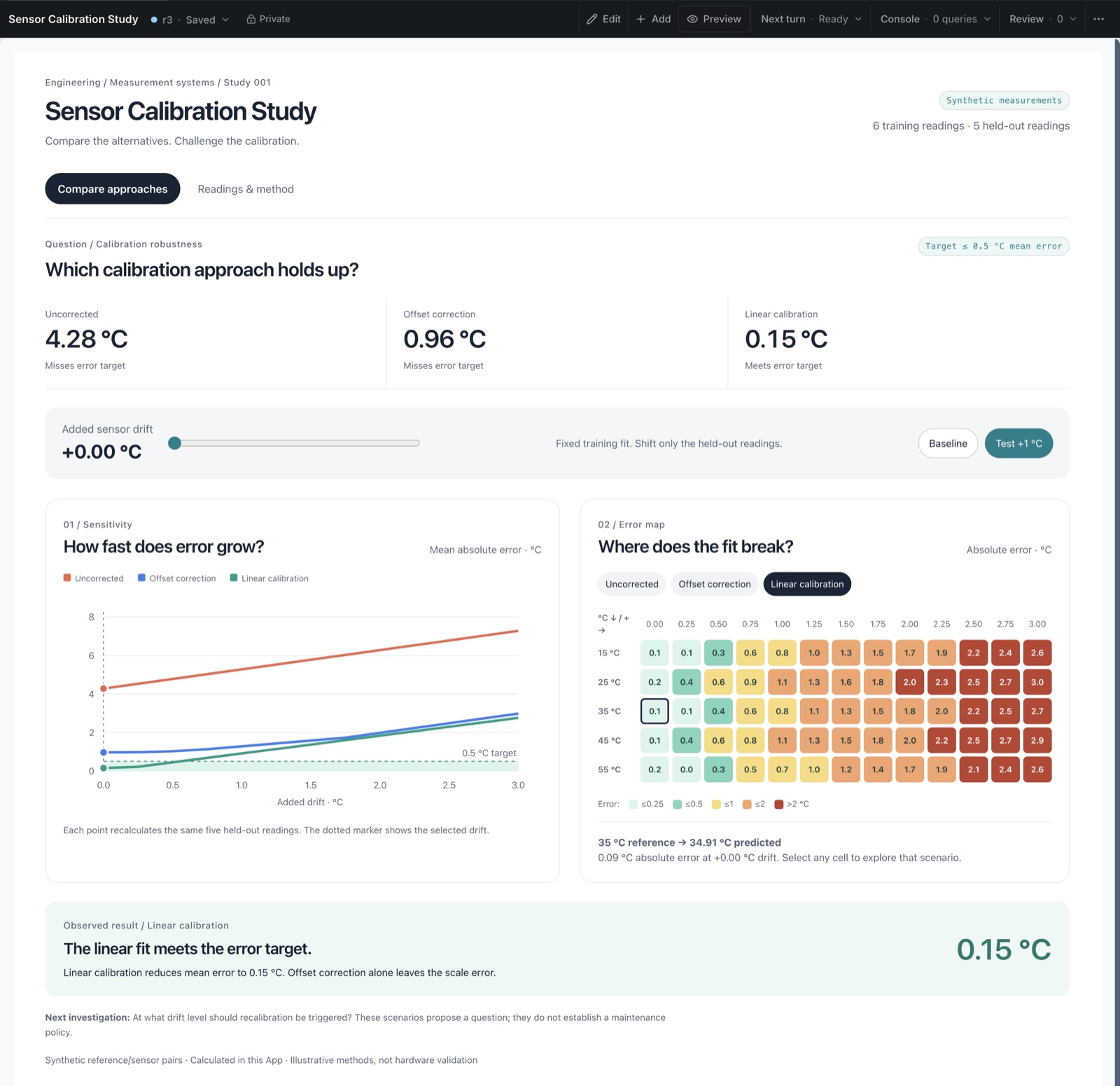
Sensor Calibration Study in Proforma, comparing three calibration methods with drift-sensitivity curves and an error heatmap on synthetic measurements.
Sensor Calibration Study · Actual product capture · Synthetic measurements
See a real experiment example

Different fields. Shared possibilities.

Find a familiar starting point.

The question changes. The opportunity to build on your work stays the same.

01

Universities & research groups

Start with one question, dataset and method.

Scope a research pilot
Inside the workflow

Research groups, research software teams and faculty.

Start with

Permitted datasets, existing analyses, research questions, and documented methods.

What you could build

Work with our team on a scoped research pilot. Example: Guided Inquiry compares two forecast methods against held-out public observations and retains revisioned evidence.

Agree one question, permitted dataset, and method. Keep the code, definitions, and working records for your next investigation. Student participation and institutional data arrangements require separate agreement.

Explore Guided Inquiry

The next investigation

Reuse the method with another dataset, examine an unexpected result, or have a colleague reproduce the analysis.

How to measure value

Track time to reproduce an analysis, prepare a demonstration and hand the work to another researcher.

02

Corporate R&D & engineering

Which approach works, and is it worth building?

Explore the R&D examples
Inside the workflow

R&D and engineering leaders, with finance partners reviewing investment.

Start with

Test fixtures, run outputs, engineering records, cost allocations and commercial assumptions.

What you could build

Compare alternatives on a reproducible fixture. Keep failed targets with the run, prepare research evidence and model the project’s expected return. Experiment Bench delivers every packet while missing its delay target. Project ROI shows why a positive simple return can still fall short of the chosen discount rate. Research-credit eligibility requires separate review.

The next investigation

Use a failed target to propose the next test. Revisit project economics when technical results or cost assumptions change.

How to measure value

Track time to compare alternatives, cost per experiment and decisions made before further project spend.

03

Investment & diligence

What does the evidence support?

Explore the diligence example
Inside the workflow

Investment teams, corporate development and diligence advisers.

Start with

Financial statements, transaction exports, customer records and diligence documents.

What you could build

Reconcile reported and adjusted earnings. Trace adjustments to supporting records, inspect concentration and compare investment scenarios. The Earnings Quality Review example keeps a $400,000 gap between the seller’s case and the supported basis visible. Scenario changes do not resolve missing evidence.

The next investigation

Revisit the scenario when new records arrive. Check which assumptions change and which evidence gaps remain unresolved.

How to measure value

Track analyst hours per review, time spent tracing adjustments and turnaround when assumptions change.

04

Business operations & planning

What should change before the next planning cycle?

Explore Forecast Lab
Inside the workflow

Strategy, operations and supply-chain teams.

Start with

Order history, inventory movements, supplier lead times and production records.

What you could build

Compare demand forecasts against simple baselines, inspect shortages and test inventory assumptions. Build a review App around the decisions your team makes each week. Forecast Lab provides a starting point for exploring time series and forecast errors. Use your own permitted data to investigate purchasing and process questions.

The next investigation

Compare forecasts with new observations and inspect errors before revising the planning assumptions.

How to measure value

Track hours per planning cycle, time to refresh scenarios and forecast error against the existing baseline.

05

Health-tech operations

Where did the operational record break?

See the health-tech example
Inside the workflow

Pilot operations, product and reliability teams.

Start with

Device logs, scheduled check-ins, collection timestamps and delivery records.

What you could build

Separate missing collection from delayed transmission. Investigate device and cohort patterns, compare retry policies and track follow-up. The Remote Monitoring Pilot Review follows 1,344 synthetic check-ins across 48 participants. It reviews operational reliability, not patient measurements or clinical decisions.

The next investigation

Compare a later collection period using the same definitions. Investigate whether the operational pattern persists.

How to measure value

Track time to investigate missing records, repeated manual checks and reliability against the chosen target.

06

Specialist advisers

Can the next review build on this one?

Discuss your review workflow
Inside the workflow

Diligence, technical and R&D tax advisers serving middle-market clients.

Start with

Client documents, technical records, cost schedules and review questions.

What you could build

Build an App around your review method. Organize evidence, identify missing records and keep calculations inspectable as client assumptions change. The R&D Evidence Review example connects technical activities, evidence and allocated costs. The adviser makes the qualification judgment; an allocation is not a claim of eligibility.

The next investigation

Bring additional evidence into the same review method, then identify what remains unsupported or needs specialist judgment.

How to measure value

Track preparation hours per engagement, evidence-request rounds and time from receiving records to a review-ready handover.

Product examples use synthetic records or identified public observations. Evaluate a pilot against your current process, including setup and review time.

One question. A place to begin.

Bring one workflow
worth improving.

Start with the work you know. We’ll help scope the inputs, a useful output, and a way to measure the difference.