skip to content

Projects

Find the constraint. Test what changes it.

Work with our team to investigate a bottleneck, evaluate a change and build the data, Apps and repeatable work behind it. Keep the evidence and methods for the next decision.

Find. Try. Measure. Reuse. One useful result, with the working materials to build on it.
Examples · synthetic data

Business Experiment Lab

What should we try next—and why?

Investigate conversion and customer quality across sales, marketing and product. Compare a change against its baseline, inspect the tradeoffs, and use the evidence to plan the next test.

3 business questions / inspectable sample results / proposed next tests
Full-size capture
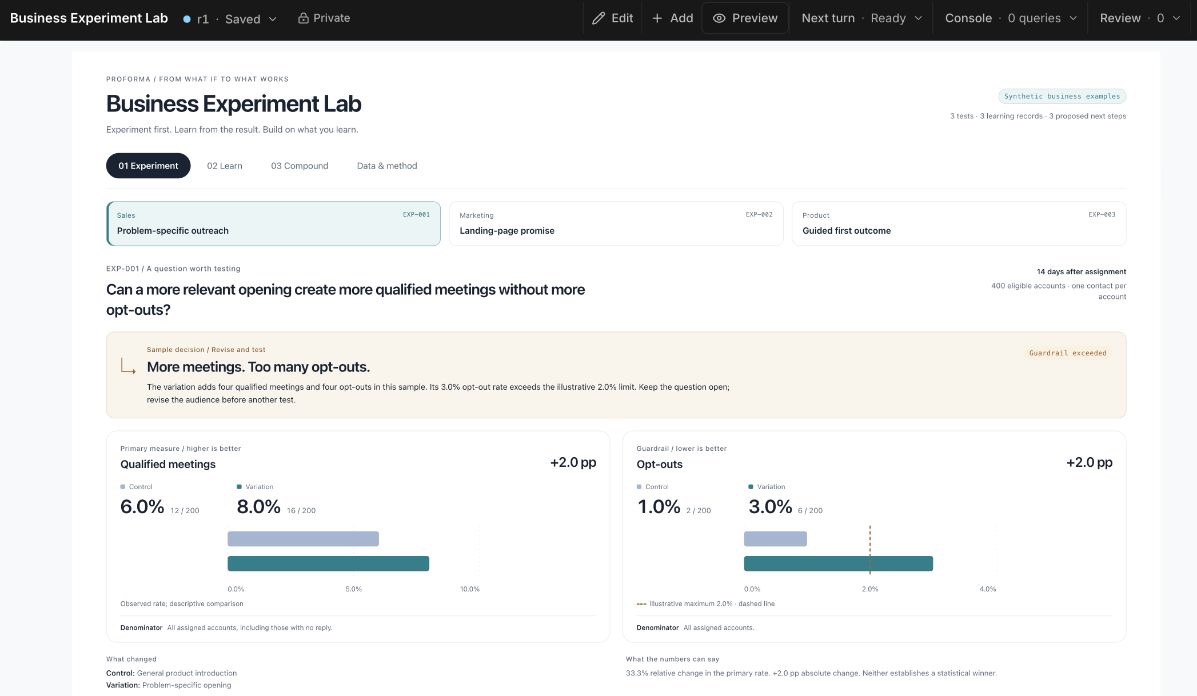
Business Experiment Lab in Proforma: qualified sales meetings improve from 6% to 8%, but the 3% opt-out rate exceeds the 2% sample guardrail.

Swipe the capture to inspect it, or open it full size.

Captured in Proforma / Sales testFictional records. Actual product interface.
Experiment
Does problem-specific sales outreach produce more qualified meetings? Compare 200 accounts per approach, with opt-outs as a guardrail.
Learn
Qualified meetings rise from 6% to 8%, but opt-outs rise to 3%, above the example’s 2% limit. More meetings alone do not justify a rollout.
Compound
Keep the finding and its limits. Proposed follow-up: retain the problem framing, tighten account eligibility, and test again. No follow-up result is claimed.

A scoped engagement

One outcome. An agreed way to evaluate it.

Agree the question, baseline, permitted evidence and intended output with our team. Define how the result will be reviewed and who can authorize a change. Scope timing, responsibilities and commercial terms together before starting.

How we work together

A method your team can build on.

A sales offer and a technical prototype need different methods. Both benefit from an explicit comparison, inspectable results and a next decision grounded in what happened. Direct analysis and evidence review remain useful starting points.

  1. 01

    Find

    Locate the constraint.

    Name the outcome and inspect the baseline. Trace missing conversions, wasted effort or a technical limit to the records and assumptions behind it. Choose the question that will inform the next decision.

  2. 02

    Try

    Evaluate a bounded change.

    Choose a method suited to the question: an analysis, simulation, operational trial or controlled experiment. Define the comparison, success measure and limits before running a test. Build the App or authorized Action the work needs.

  3. 03

    Measure

    Review the result and trade-offs.

    Compare outputs with the baseline and source evidence. Inspect costs, quality and other measures that must not deteriorate. Distinguish observations from modeled outcomes and interpretations before choosing what to do next.

  4. 04

    Reuse

    Carry the learning forward.

    Record what the evidence supports, its limits and the next decision. Keep the code, definitions and working records in your workspace so another review or test can build on them. Agree what to adapt, repeat or stop.

Where to start

Choose the outcome. Adapt the method.

Investigate revenue, test a customer offer or work through technical uncertainty. These briefs show possible scopes; the data, method and review requirements follow the question.

Example project brief

Diligence

Question
Does the reported revenue hold up when contracts, invoices, cash receipts, and customer cohorts are examined together?
What the app could do
Build a review app that reconciles records, compares customer cohorts, and lets reviewers inspect exceptions beside their source documents and calculations.
What it helps you decide
Investigate unexplained differences, customer concentration, and assumptions before deciding where to dig deeper. The investment decision remains a separate judgment.

Work with us

Bring one outcome worth improving.

Start in the workspace yourself, or work with our team and specialist partners to prepare data, implement an analysis, build an App, or review the evidence. Define what to measure and keep the findings and working tools in your workspace for the next cycle.