Security
Your work. Your boundaries.
Interactive apps need clear controls around data, code, and agent access. Proforma uses scoped permissions, inspectable revisions, bounded execution, and reviewable run history.
The control model
Control is part of how the work runs.
Permissions govern which data an agent can read and which work it can run. Source revisions and execution records help your team inspect the analysis behind a result.
- 01
Scope
Give every agent and executor only what the job needs.
Inbound agents receive one Workspace and explicit explore, build, or operate scopes. Outbound executors receive a bounded assignment and eligible repository allowlist. Both grants remain visible and revocable.
- 02
Inspect
Keep the logic behind the work visible.
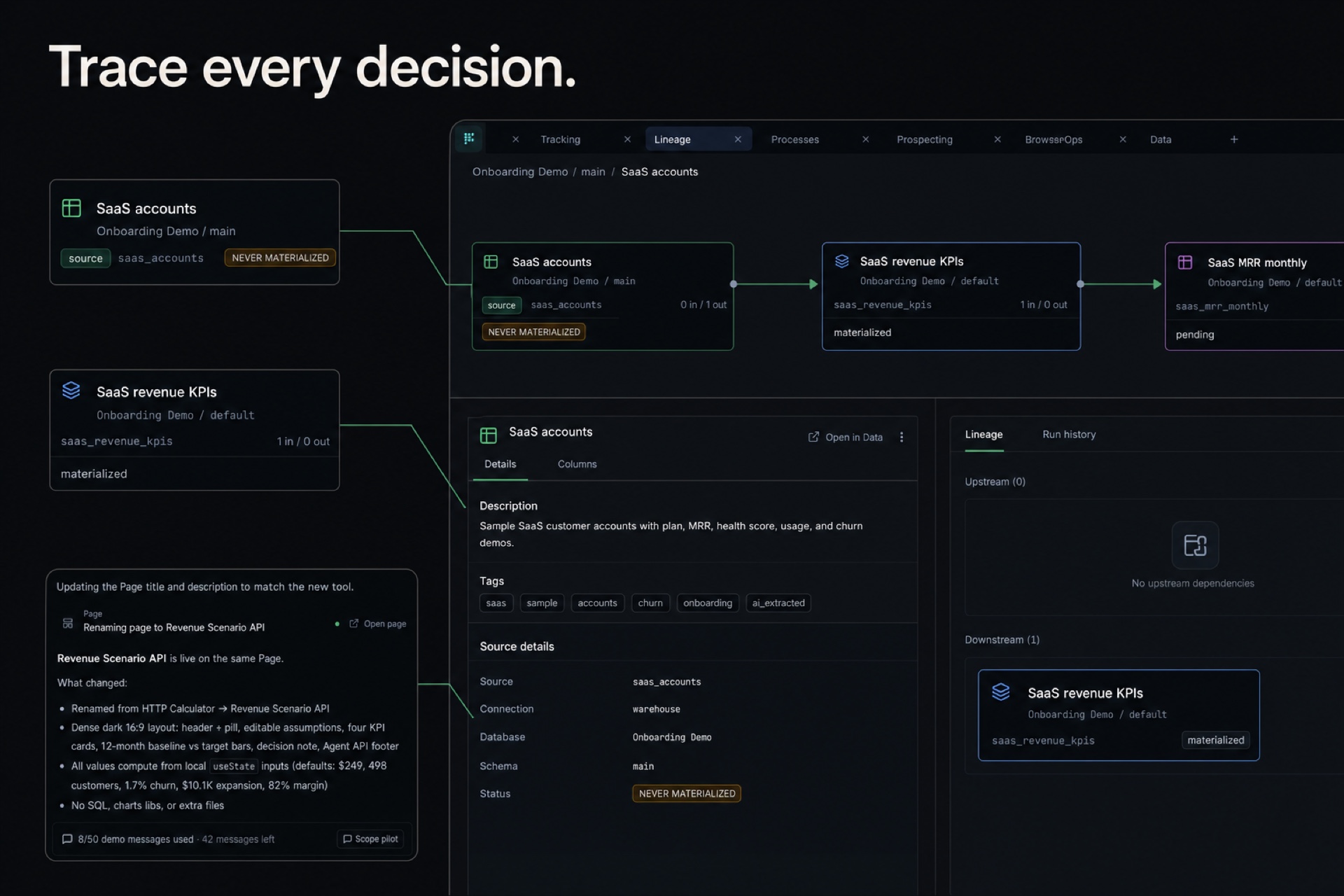
Files, Apps, and Actions keep revisions. Every Action run records the exact source revision, manifest, capabilities, and budgets it used.
- 03
Constrain
Declare what code can reach and change.
Actions name their resources and side effects. Runtime ceilings continue through nested work, limiting access, outbound hosts, rows, nesting, and execution time.
- 04
Review
Leave a record of what ran and what came back.
Runs record output, redacted logs, duration, and terminal state. Executor assignments return normalized status, usage, branch, and pull-request evidence for review.
Default boundaries
Make each grant deliberate.
The browser authorization path shows the requested grant before approval. More authority remains explicit, visible, and revocable.
- No raw credentials
- Browser-authorized coding agents do not receive warehouse credentials or stored Workspace secret values.
- No hidden data authority
- Raw Source rows, arbitrary SQL, and Model access outside the approved policy are not granted by default.
- No inherited production authority
- An executor assignment may return a branch or pull request; it does not grant merge or production-deployment authority.
- No public back door
- Public Apps are pinned to a revision and cannot run Actions, accept arbitrary SQL, or open the Workspace for collaboration.
Before implementation
Set the scope before you begin.
Tell us about the data, analysis, and people involved in your work. We can review access, execution, and deployment requirements with your team before implementation.